
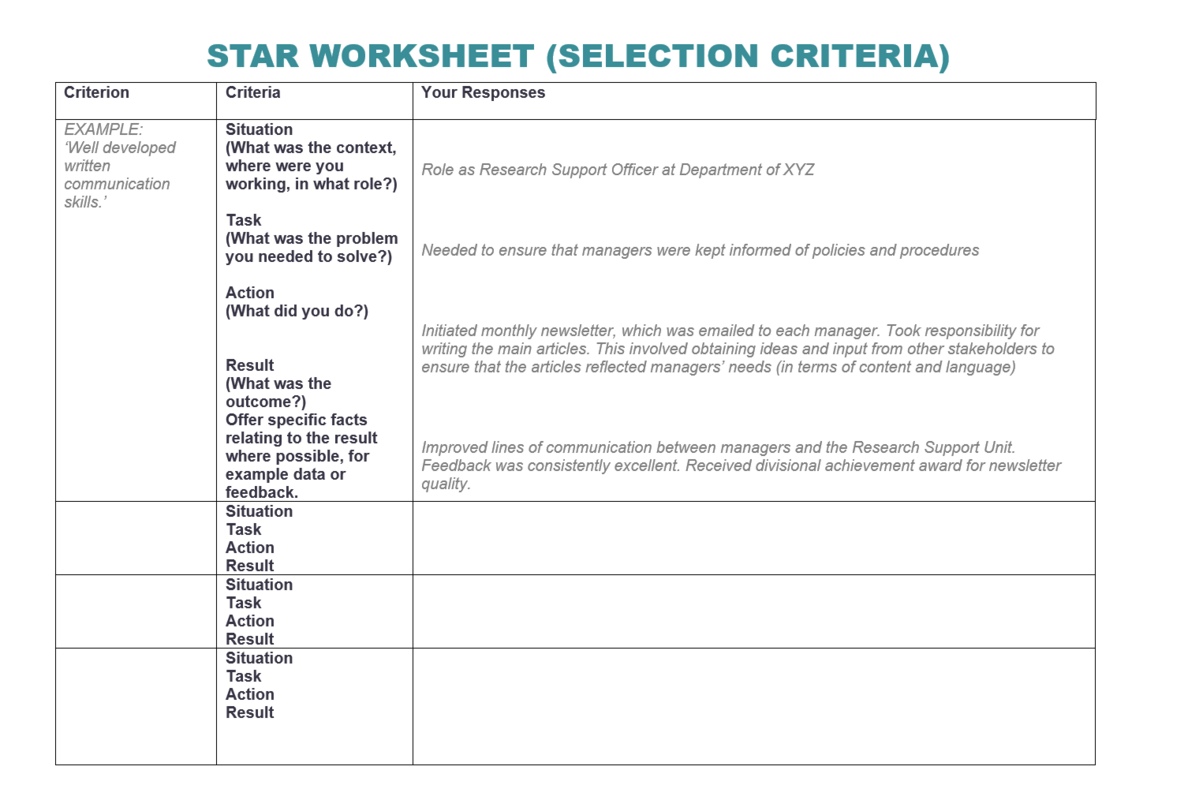
Still writing government criteria the panel cannot score?
You have used STAR. You have answered every line. The file still reads like a second résumé. Here is what they are actually marking.
The document is full. That is not the same as scored.
You did not sit down tonight hoping for another article about Situation, Task, Action and Result.
You sat down because the ad wants criteria, or a statement of claims, and you already have a draft. Every heading has a paragraph. You named a project. You used I. And you still cannot tell whether a stranger on a panel could mark it.
That is a different problem from a blank page. The page is finished. It just does not give them a scene they can score against the job they advertised.
I see this a lot. People who can do the work, sending a file that would make a fair panel guess.
Read this vacancy before you reuse the last one
The instruction is not decoration.
Some ads want Key Selection Criteria: a labelled answer under each heading, one story at a time. Some want a statement of claims: one piece of writing that covers the capabilities without five mini-essays glued together. Some want a short pitch. Some want the statement and the résumé, and they will sit longer with the statement.
Key Selection Criteria want discrete evidence. A statement of claims wants synthesis, still with a real piece of work in it, still in your voice. If you paste last year's five STAR blocks into a one-page statement, you have not tailored the file. You have filled the space.
Look at the closing instructions again. A word or page limit is not a target to hit for its own sake. If there is no limit, a shorter answer they can mark will beat a long one that thins out your part.
Federal, state and council rounds do not share one template. New South Wales, Queensland, Victoria and Western Australia often use different words for similar behaviours. One place talks about community and service. Another talks about delivery under regional constraints. Federal capability language pasted onto a council ad looks borrowed.
What they are marking, in ordinary words
Government hiring is a merit process. The panel has descriptors. They compare your page to those descriptors so two candidates can be assessed without a vibe.
That is why "I am a strong communicator" does not move the mark. They already expected that. They need enough context to picture the work, the task that was yours, the actions you took when it was not straightforward, and a result they can believe.
STAR is not a slogan. It is a way of making those four things visible.
Situation and Task can be short. Where were you, and what were you actually responsible for. Action and Result are where the score lives. What did you do, in order. What changed because you did it. A backlog that moved. A briefing that did not have to be rewritten. A risk that stayed visible instead of becoming a surprise.
"We" hides who did the work. If you led it, say so. If you were one of four, say what your part was. Panels cannot give you a capability rating for a team they cannot see.
You do not need a number for every line. If you have a figure you would be calm repeating in a room, use it. If you do not, a plain outcome is cleaner. Invented percentages have a way of coming up later.
One story per criterion is enough. Listing every job you have held makes the answer long and the evidence hard to find.
Pitch the story at the level they advertised
Read the capability descriptor for the classification in the ad, not the one from a role you liked last year.
Entry and early professional work can come from study, volunteering, or a part-time role if you write what you actually did. They are looking for initiative and a Tuesday they can picture, not a pretend decade.
Mid-level work needs a piece you owned: a problem, a decision, a result you stayed with after it landed.
Management needs people, money or risk, and a decision under pressure. Who you developed. What you stopped, or started, when the brief was messy.
Senior work needs the scale. Policy, governance, a stakeholder group that was not going to move on its own, the thing that changed because you were in the room.
If you write an operational story for a role that asked for strategic judgement, you look junior. If you write a strategy essay for a role that asked for a clean piece of service delivery, you look like you did not read the ad.
Write the scene first. Then add the words the ad used, where they are true. If the term is not true of your week, leave it off. The interview will ask.
The mistakes that hide a good career
These are ordinary. I see them on tidy files.
A situation so vague it could belong to anyone: "in a previous role I managed stakeholders."
A result that says the project was successful, and nothing else.
The same story, slightly reworded, under every heading.
Keywords from the ad listed at the top, not lived in a sentence.
A résumé that says one level of authority and a statement that says another. Dates, titles and scope have to line up. An unreconciled file is an easy one to set aside.
Tailoring is not a keyword dump. Highlight the capability terms. Pick the recent story that matches that behaviour. If the detail has gone fuzzy, choose a more recent piece of work. Impressive-but-vague does not score.
What the software is doing, and what it is not
Some portals pull text out of the file. They are not a personality test.
Text sitting inside images, unusual fonts, and tables that looked tidy in Word can arrive as noise. Use ordinary headings for each criterion. A .docx or a text-based PDF. Short paragraphs. If a phrase from the ad is true of your work, it should appear in a real sentence, not in a box at the bottom.
I will not quote a pass rate. A file a human can mark is usually a file the software can read.
You do not owe anyone a purchase
You are allowed to write your own life. Plenty of people write their own criteria and get the hearing.
Help starts to earn its keep when you cannot see the file anymore. The statement and the résumé tell two different stories. You are applying across jurisdictions and the language will not sit still. The applications have gone out and the inbox has stayed ordinary.
A useful service will talk to you. They will write in a voice you can stand beside in an interview. They will tell you what they will not put on the page. If they cannot explain how they work, keep looking. You are not buying a template.
A calm next step
If you want a personalised look at the role and the draft, send it through. Say whether it is Key Selection Criteria, a statement of claims, or a short pitch, and which jurisdiction.
I will tell you whether a panel can score what is there, and whether you can fix it yourself.
You do not need another template with a date on it. You need a page they can mark.