
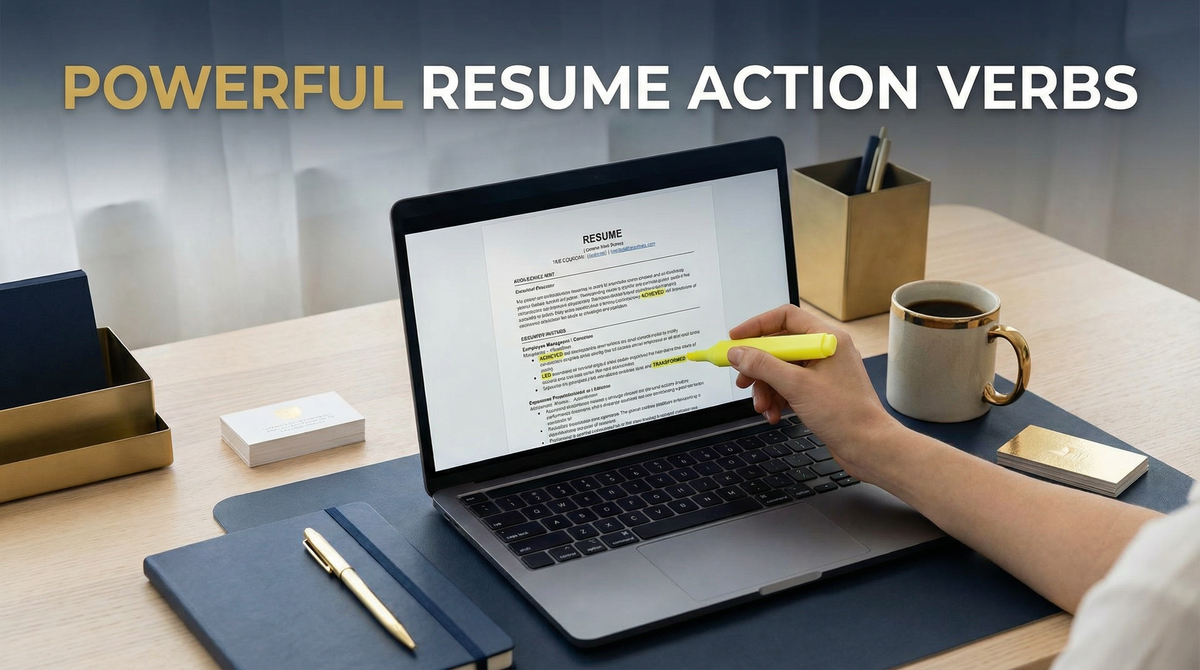
You swapped the verbs. They still cannot see the work.
Led. Spearheaded. Delivered. The lines still end nowhere. Here is how to write the week, not a verb list.
The advice that sounds like a fix
You did not sit down hoping for another list of leadership verbs.
You sat down because a role fitted, and someone told you the problem was the language. Responsible for. Helped. Worked on. So you opened a list. You swapped the weak words for stronger ones. The file looks more energetic. It still does not sound like a person who did the job.
I see this a lot. The old bullet said you were responsible for onboarding. The new one says you spearheaded onboarding. Same duty. Louder word. Or it says you optimised workflows and then invents a percentage you have never seen in a report. That is not stronger. That is a sentence you will have to defend in a room.
Hiring managers are not scoring your thesaurus. They are trying to see whether you have done this kind of work, at this kind of level, and what changed when you did it. If the line could sit on anyone in the industry once you change the job title, the verb did not save it.
A useful verb is not a decoration. It is the start of a sentence you would be willing to say out loud.
The verb has to be true of Tuesday
Start with the week, then pick the word.
What did you actually hold. A queue. A roster. A budget. A messy handover. A stakeholder who would not stay in the process.
What did you actually do. You ran it. You fixed the bit that kept breaking. You wrote the thing the next person could use. You sat in the meeting and made a call.
Then choose a verb that names that, not a verb that sounds senior.
Assisted is honest if you supported someone else's work. Led is honest if people waited on your decision. Implemented is honest if you put something in and it stayed. Spearheaded is only honest if you started it and carried the risk.
A quieter verb with a real scene will beat a louder verb with no scene. Every time.
After the verb, something has to happen
Name the action. Name what it sat on. Name what was different afterwards.
You do not need a figure on every line. If you have a number you would be calm repeating, the one from a report, a dashboard, a conversation with your manager, use it. If you do not, a plain result is cleaner. A backlog that moved. A process that stopped breaking. A new person who could start without a second briefing.
Responsible for social content becomes: wrote and scheduled the weekly posts so the channel stayed live when the team was short.
Helped with onboarding becomes: ran the first-week walkthrough so new starters could do the job without sitting next to you.
Worked on vendor agreements becomes: negotiated the supplier terms the finance team then used.
Those lines work because they end somewhere. The verb is only the first word.
Do not use the same strong word on every line
If every bullet is spearheaded, none of them are.
Read the last role out loud. If three lines start with the same word, two of them are covering for a thinner sentence. Keep the one that is true. Rewrite the others from the week.
A short swap list is enough. You do not need five categories and a table.
- Responsible for: name the action you actually did.
- Helped / assisted: say what you held, and what still needed someone else.
- Worked on: name the deliverable, not the participation.
- Managed: only if you owned the people, the money, or the decision. Otherwise say what you kept moving.
Entry-level files can stay with coordinated, researched, supported, as long as something happened. Mid-level files need ownership: what you put in, what improved, who no longer needed you in the room. Senior files need scope: across which teams, at what risk, with what decision. Do not borrow the senior list if the week was not senior. The interview will ask.
Gaps, changes, and the letter next to the file
A gap does not need a heroic verb. Parental leave, carer, study, contract ended, relocation. If you did skilled work in that time, unpaid or freelance, write the work in ordinary language. Do not invent a consultancy so the timeline looks busy.
If you are changing field, the old industry verbs will keep writing you back into the last job. Name the transferable week: the people, the problem, the thing that shipped. Leave the jargon that only made sense in the last workplace.
A cover letter can use the same verbs. It should not copy the bullets. The résumé line is short. The letter can say why that Tuesday matters for this vacancy.
What the software is doing with those words
Applicant tracking systems pull text out of a file and look for a match with the vacancy. They are not scoring your verb catalogue.
If the ad uses a word that is true of your week, that word should appear in a real sentence, near the top and again in the role where you did it. Led a project. Analysed the data. Looked after the client relationship. Use the employer's language where it is true. Do not paste a synonym list so the file looks busy.
I will not quote a pass rate. I will not tell you that a particular verb lifts your ranking. A file a human can read is usually a file they can read.
Australian pages have their own habits
Write in Australian English. Résumé, unless the ad asked for a CV. Latest role first. Suburb, state and postcode.
If you are applying for APS, state, council or a university post, the statement next to the file has to sound like the same person. A résumé full of championed and orchestrated, and a criterion that says "I have demonstrated experience," will not read as one voice. Tell the same Tuesday in both places.
Local terms belong on the page when they were your week. Stakeholder engagement, if you actually held the stakeholders. Commissioned, if you signed it off. Compliance, if you lived inside the rule. Do not drop them in because a list said they were Australian-specific.
You can still do this yourself
Plenty of people never buy a verb rewrite and still get the conversation.
If you can make the first screen sound like you, start each recent bullet with a word you would say, and end the line with something that changed, you may not need anyone this week.
Help starts to earn its keep when you cannot see the page. Every line starts with a loud verb and goes nowhere. There is a percentage you would not repeat. The applications have gone out and the inbox has stayed ordinary.
Then a second pair of eyes is a reasonable ask. Not because a site promised to transform the file. Because you are being misread.
If you want a look at the file, send it through. Say the kind of role, and whether you have already had the verbs rewritten. I will tell you what the page is currently saying, and whether you can fix it yourself. Sometimes it is three sentences. Sometimes someone gave you a louder duty list and called it achievement.
You do not need another category of action verbs. You already have those. That is why the lines still sound the same.